


Launch of Roadmap for Social Inclusion 2026-2030
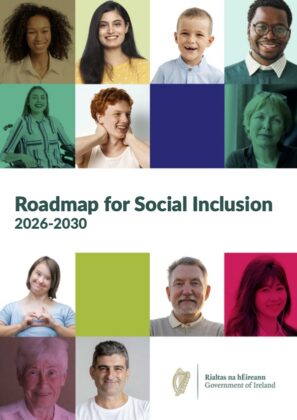
EAPN Ireland welcomes the publication of the Government’s new Roadmap for Social Inclusion 2026-2030, the latest plan in Ireland’s almost 30 year history of Anti-poverty strategies. While undoubtedly progress has been made over the past three decades, fundamental problems remain and are recognised in the new Roadmap.
It pinpoints the groups which are disproportionately impacted by poverty & inequality- lone parents, children, older people, disabled people and marginalised communities, and highlights the need for supporting voluntary & community activity, and inclusive growth in terms of labour market participation and strong social protections as a means of addressing this disparity.
The overall ambition of the present plan is ‘To reduce consistent poverty to 2% or less by the end of 2030, reduce income inequality, and make Ireland one of the most socially inclusive countries in the European Union.’ This is a roll-over of the same target that has existed in the last two plans, and should have been achieved by 2020. Yet at the close of the last strategy, 4.7% of the population, more than double the target, were living in consistent poverty[1]. In fact the level remained virtually the same at the end of the last strategy, as it was at the beginning. Over a period of strong economic growth, almost full employment and buoyant tax revenues, this is not good enough. It requires a serious examination of previous approaches.
The present Roadmap maintains the same overall ambition of the previous one with the addition of reducing income inequality. This is an important addition. As the Roadmap states; ‘The broader appreciation that a person’s sense of poverty/exclusion is relative rather than absolute is particularly important for developed economies such as Ireland. The challenge of ‘poverty’/’exclusion’ is not solved simply by becoming ever wealthier, what matters is how that wealth is distributed among people and how it is used to deliver services to the benefit of community/society.’ We agree. Combating poverty is as much about quality, accessible public services, as it is about income adequacy, and can be delivered through a progressive redistributive tax system. Therefore in order to be successful, the present strategy cannot be delivered by isolated targets, but only through an integrated approach across multiple government departments. It is only by measuring impact on the lives of real people, that success, or otherwise, can be evaluated.
We welcome that the strategy has simplified the number of actions and focused less on inputs such as producing reports, but the actions alone are not enough. Effective monitoring of the impact of the actions at every stage of the strategy is absolutely necessary in order to secure effective implementation. The proposed continuation of the Social Inclusion Roadmap Steering Group is an important first step, but the community & voluntary external members must be treated as equal partners, worked with, and listened to, collaboratively, rather than reported to twice a year. Oversight of progress to Government through the Cabinet Committee on Justice, Migration & Social Affairs, and the presentation by the Minister for Social Protection of the annual progress reports and mid-term review to the Joint Oireachtas Committee can be important steps forward in the transparent delivery of the strategy and the advancement of a whole of government approach.
The dots need to be joined. This will not be solved by the Department of Social Protection alone. Focusing on core essentials and ensuring ‘that all people have their essential needs met, including adequate and good quality food, secure housing, energy and healthcare’ is a good starting point, but can only be achieved by a genuine whole of government and indeed whole of society approach.
For example; Annual poverty statistics show very clearly that housing costs are a major factor in putting people at risk of poverty. If the cost of rent and mortgage interest were deducted from people’s income the at risk of poverty rate would be 19.7% in 2025, instead of 12.6%. Almost half (45.2%) of those living in rented or rent-free accommodation would have been at risk of poverty after their rent is deducted, compared to 24.2% beforehand.[2] Lack of affordable housing is also a barrier to people taking up employment. Given the scale of the problem, it is concerning that only one of the 65 actions relates to the Department of Housing. There needs to be broader inter-agency co-operation to address this issue, it is not simply a question of supply, but critically affordability. Previously social housing tenants benefited from a differential rent scheme, paying 11% of the principal earner’s income, and a fixed amount for every adult. This has been dismantled at the same time as adult children remain living with their parents due to a lack of alternative accommodation and family rents rocketing as a result and preventing those young adults from saving and acquiring their own home, compounding the problem. The restoration of this scheme in co-operation with local authorities should be examined.
Similarly, there is appropriate reference made to the changing demographics in Ireland, and the fact that age related expenditure will account for 46% of all expenditure by 2030. Meanwhile it is recognised that rising ethnic diversity requires a need for targeted integration supports. We have an aging population, and need migrant workers to sustain our economic development. Yet policies are being implemented by other departments which is cutting across this. Asylum seekers are prevented from working for six months, while changes are being made to the criteria for General Employee Permit Holders, who require an annual income of €50,200 to sponsor a family member, and must wait twelve months before they can apply for family reunification, in reality two or three years before the application is processed. How can migrant workers properly integrate and be included in Irish society if they are prevented from accessing the family care supports that everyone in Ireland depends upon? Implementation of the Roadmap requires that these inconsistencies, and others, are addressed.
There are specific actions outlined for groups disproportionally impacted by poverty which have the potential to deliver results but these need to be implemented, monitored and evaluated if they are to be successful.
We look forward to working with the Department to achieving not just the reduction of poverty but its eradication. The Roadmap recognises that addressing poverty is not a cost, it is an investment that yields benefits not just for those impacted, but for everyone. This is a necessary and urgent task that can and must be delivered.
[1] https://www.cso.ie/en/releasesandpublications/ep/p-silc/surveyonincomeandlivingconditionssilc2025/
[2] https://www.cso.ie/en/releasesandpublications/ep/p-silc/surveyonincomeandlivingconditionssilc2025/
Related Post
-

PRESS NOTICE - BUDGET 2027 WHERE'S the WEALTH TAX?
22-Jun-2026 -
Global Inequality is Threatening the World
22-Jun-2026 -
Major Anti-Poverty Event Galway Oct. 16th
22-Jun-2026 -
EAPN PRE-BUDGET SUBMISSION BUDET 2027
22-Jun-2026